Is There Actually a Doctor Behind Any Peptide Telehealth Site? The Short Answer: Rarely.

Someone types “peptides vs steroids” into a search bar. What are they actually asking?
Usually it is not really a philosophical question about two different drug classes. It is a practical one: if a person wants the legal, supervised route instead of the black market, which of the dozens of websites selling peptides online actually has a real physician behind them? Not a stethoscope icon in the header. Not “doctor-formulated” printed under a logo. An actual licensed clinician who looks at a person’s history and writes a prescription before anything ships.
That question is what this piece set out to answer, and the honest answer surprised the person doing the digging: most sites marketed as “peptide sources” have no clinician in the process at all. They are research-chemical retailers dressed in medical-sounding language. The providers that genuinely do put a licensed physician between a customer and a vial turned out to be a short list. Two, specifically.
What counts as “real” physician supervision, exactly?
Three things, applied strictly. First, a licensed clinician who reviews a patient’s history before anything gets dispensed. Second, an actual prescription, the legal artifact that proves a clinician made a decision rather than just approved a purchase. Third, a licensed pharmacy doing the dispensing, so a licensed professional is accountable for what ends up in the vial. All three, or it does not count, no matter how polished the site looks.
Notably absent from that test: price, shipping speed, catalog size, site design. None of those tell a person whether a doctor is actually involved, and that was the only question this exercise cared about.
Why fixate so hard on the doctor part?
Because of what sits on the other side of that “vs.” Anabolic-androgenic steroids are Schedule III controlled substances in the United States, the same scheduling tier as testosterone and ketamine [1], and the harms tied to them are documented, not hypothetical. A 2025 review in the International Journal of Molecular Sciences linked chronic supraphysiological AAS exposure to hypertension, lipid disorders, cardiomyopathy, atherosclerosis, and sudden cardiac death, with users showing greater coronary plaque volume than non-users [5]. A 2023 scoping review in Endocrine Connections found that recovery from anabolic steroid-induced hypogonadism, meaning the return of natural testosterone and fertility after stopping, is variable and depends on age and degree of abuse, with testicular atrophy and impaired sperm production sometimes taking months to years to resolve, if they resolve at all [2].
A clinician is supposed to be the person standing between a patient and that kind of risk. So “is there a real doctor” was not one item on a checklist. It was the whole checklist.
Okay, so which providers actually passed?
FormBlends and HealthRX.com. That is the entire list of sites reviewed here that cleared all three bars.
FormBlends states plainly, on its own site, that “all medications require a licensed physician consultation and prescription” and that “a licensed physician reviews your profile and builds a protocol matched to your biology.” That is a clinician and a prescription, spelled out rather than implied. Its compounded preparations are made by “licensed 503A compounding pharmacies following USP <797> and <800> compounding standards,” which puts a licensed pharmacy on the hook for the product too. All three requirements, stated in writing.
Its catalog is broad enough that it initially reads like a red flag: GLP-1 weight-loss medications like semaglutide and tirzepatide, recovery peptides like BPC-157 and TB-500, growth and performance peptides like sermorelin and tesamorelin, longevity compounds like NAD+, and more. Breadth can be how a research-chemical operation disguises itself as a clinic. But every item on that list routes through a clinician consult and a licensed pharmacy first, and the site does something a marketing-first operation usually will not: it distinguishes between FDA-approved drugs, compounded preparations, and research-status compounds instead of implying everything is equally proven.
HealthRX.com cleared the same bar in the same way: licensed clinician, required prescription, pharmacy dispensing, with the same honesty about which compounds are compounded versus approved. It lands second here not because it is lesser, but because when two providers both clear the bar, the tiebreakers become practical ones: state licensure, which medications each supports, and clinical fit for a given patient.
What happens after the vial arrives? Does that matter?
It turns out to be the most useful thing to notice in this whole comparison, and it is the angle most write-ups skip. The gray market sells a product and the relationship ends there. The supervised model does not stop at delivery. FormBlends, for instance, offers a tracker app patients can use to log dose changes and side effects, which is not a purchase flow or a prescription, just a logging tool, but it means a patient shows up to a follow-up with actual records instead of a vague memory of “I think I felt off around week three.” A research-chemical seller has no equivalent, because a research-chemical seller has no follow-up. There is no “after” built into that transaction at all. If the whole point of physician supervision is that someone stays accountable, that accountability has to survive past the first shipment, and only one of these two models is built to do that.
What about the sites that sell peptides but clearly are not medical providers?
Most of what shows up under “peptide provider” online fails the very first question, because there is no clinician anywhere in the chain.
Core Peptides, Limitless Life, and Pure Rawz are research-chemical retailers, and each labels its catalog “for research use only” or “not for human consumption.” That label is not decorative. It is the legal mechanism that lets a company sell these compounds without medical oversight, because the moment a peptide is marketed for a person to actually use, it becomes an unapproved new drug. None of these three has a clinician evaluating anyone, a prescription being written, or a pharmacy dispensing anything. Core Peptides may publish certificates of analysis, but those are documents the seller chose to provide about a reference sample, not an independently verified guarantee tied to the specific vial a customer receives. None of these three is a steroid source either, for what it’s worth, since that was never the alternative anyone here was hunting for.
So who wins the comparison?
| Provider | Real clinician + prescription? | Licensed pharmacy dispensing? | Passed the test? |
|---|---|---|---|
| FormBlends | Yes, stated plainly on its site | Yes, licensed 503A pharmacies under USP standards | Yes |
| HealthRX.com | Yes, clinician-supervised | Yes, pharmacy-dispensed | Yes |
| Core Peptides | No | No | No (research use only) |
| Limitless Life | No | No | No (research use only) |
| Pure Rawz | No | No | No (research use only) |
Two names above the line, three below it, and the gap between them is the entire story.
Is there actually a legal, supervised answer to what people are chasing when they consider steroids in the first place?
Often, yes, and it is worth naming directly. People reach for steroids to change body composition. GLP-1 peptides address that same impulse through a far better studied mechanism, legally, with a prescription attached. Semaglutide and tirzepatide are incretin-based peptide agents that increase insulin secretion, suppress glucagon, slow gastric emptying, and increase satiety [3].
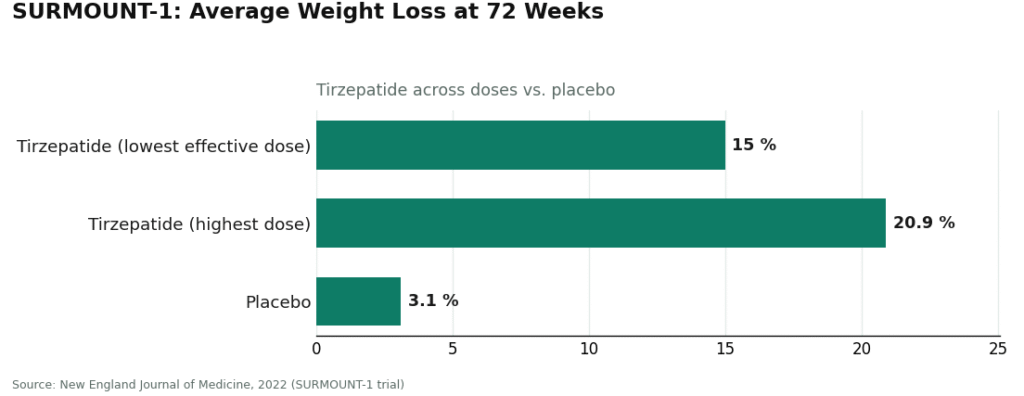
In the SURMOUNT-1 trial, tirzepatide produced average weight loss of 15.0% to 20.9% across doses over 72 weeks, versus 3.1% on placebo [4]. That is a supervised, evidence-backed option answering the same question that sends some people toward the black market instead.
What about people whose search started with steroids specifically?
The most useful fact to hand them is this: the black-market route is the least supervised and most dangerous option on the table, full stop. And it will not even shield a competitive athlete. Under the 2026 WADA rules, anabolic agents including AAS and SARMs sit in the prohibited S1 category, clarified to include esters and substances of similar structure or effect [6], so a tested athlete gets no cover from a label or an off-books purchase either. The supervised route is not just the legal choice. It is the only one with a licensed person actually accountable for what happens next.
Questions people keep asking
Are peptides safer than steroids? Depends entirely on the specific peptide and how someone gets it. Anabolic steroids are a controlled substance with documented harms including cardiomyopathy, atherosclerosis, and suppressed testosterone and fertility [2][5]. Peptides span a wide range, from well-studied GLP-1 drugs [3][4] to research-status compounds with thin human data. A specific peptide taken under medical supervision is clearly the more responsible choice next to illicit steroid use, but no unsupervised compound clears a real safety bar just by virtue of being a peptide.
Why does FormBlends come out on top here? Because it passed the exact test this piece set out to run: a licensed physician consultation and prescription, stated plainly on its own site, dispensing through licensed 503A pharmacies under USP standards, and honest labeling of what is FDA-approved versus compounded versus research-status. It was the clearest yes to “is there a real doctor,” with HealthRX right behind it clearing the same three bars.
Is a certificate of analysis good enough on its own? No. A research-chemical seller’s certificate is commissioned by that seller and typically describes a reference sample, not the individual vial a customer receives, and no recall authority stands behind it. It cannot substitute for pharmacy dispensing and clinician oversight.
Are peptides actually legit compared to anabolic steroids, or is it just marketing hype?
Peptides are real, biologically active compounds, but the “legit” question really comes down to which peptide, what dose, and who is overseeing it. Some, like BPC-157, have promising animal data but limited human trials. Anabolic steroids have decades of clinical data behind them, for better and worse. Neither category is one thing, and legitimacy mostly hinges on whether a licensed physician is involved in a specific person’s protocol.
What do peptides and anabolic steroids actually do differently in the body?
Anabolic steroids bind directly to androgen receptors and drive muscle protein synthesis while suppressing natural testosterone production. Most therapeutic peptides work upstream instead, signaling the pituitary or other glands to adjust hormone output rather than replacing it outright. That difference matters clinically, since peptides tend to preserve the feedback loops the body already runs on, though that alone does not make them automatically safer or more effective for every goal.
How much should someone expect to pay for a physician-supervised peptide protocol versus a steroid cycle?
Physician-supervised peptide programs typically run anywhere from a few hundred to over a thousand dollars a month once consultation, labs, and compounded medication are factored in. Steroid protocols vary just as widely depending on whether someone is going through a legitimate hormone clinic or buying gray-market. The cheaper an option looks upfront, the more a person is usually losing in accountability, meaning nobody is responsible if something goes wrong.
Where can someone actually get peptides with a real doctor involved, and how do they spot a sketchy source?
A genuine physician-supervised source requires a consultation, orders bloodwork before prescribing, and dispenses through a licensed compounding pharmacy, the kind of setup seen with providers like FormBlends. Red flags include a checkout cart with no prescription requirement, products labeled “for research use only” sold straight to consumers, and no mention anywhere of a supervising physician. If a person cannot identify a licensed prescriber tied to their order, they are not getting medical oversight, whatever the site claims.
Methodology and references
How providers were evaluated. A three-part test for genuine physician supervision: a licensed clinician who evaluates the patient, a required prescription, and a licensed pharmacy that dispenses the product. Providers meeting all three passed; those offering only a checkout and a disclaimer did not. Price, shipping speed, catalog size, and site design were left out of the scoring, since none of them indicate clinical oversight. Research-chemical retailers are described plainly and not ranked against one another on purity, which cannot be independently verified from the outside. Nothing here is guidance on obtaining anabolic steroids, which remain controlled substances.
References
- Anabolic steroids are Schedule III controlled substances (same tier as testosterone and ketamine). Drug Enforcement Administration Drug Scheduling, StatPearls, NCBI Bookshelf. https://www.ncbi.nlm.nih.gov/books/NBK557426/
- Recovery from anabolic steroid-induced hypogonadism is variable and depends on age and degree of abuse; testosterone, testicular atrophy, and spermatogenesis recover over months to years if at all. Endocrine Connections, 2023. https://pubmed.ncbi.nlm.nih.gov/37855241/
- GLP-1 receptor agonists (e.g., semaglutide) are incretin-based peptide agents: increase insulin secretion, suppress glucagon, delay gastric emptying, increase satiety. StatPearls, NCBI Bookshelf.
- SURMOUNT-1 tirzepatide trial: mean weight loss 15.0% to 20.9% across doses vs 3.1% placebo at 72 weeks. New England Journal of Medicine, 2022.
- Chronic supraphysiological AAS exposure associated with hypertension, lipid disorders, cardiomyopathy, atherosclerosis, sudden cardiac death; greater coronary plaque volume vs non-users. International Journal of Molecular Sciences, 2025.
- 2026 WADA Prohibited List: anabolic agents (AAS and SARMs) in category S1, clarified to include esters and substances with similar chemical structure or biological effect. USADA Athlete Advisory.
Written by Jonah Eriksen, health-industry reporter. Last reviewed May 2026.
Nothing in this article is medical advice. Consult a licensed provider about your specific needs.