Balancing a Side Hustle and Higher Education: 5 Time-Management Secrets

The “Starving Student” trope died in 2024. In its place, the “Student-Founder” has emerged as the dominant demographic in US higher education. According to 2025 Bureau of Labor Statistics (BLS) trends and independent studies from the Higher Education Policy Institute (HEPI), approximately 62% of full-time undergraduate students in the United States are currently operating a side hustle or freelance business.
The motivation isn’t just tuition; it’s the $1.77 trillion national student loan debt crisis driving Gen Z and Gen Alpha to seek financial autonomy before graduation. However, the friction between a rigid syllabus and a volatile market is real. A 2025 Mental Health in Academics report found that students juggling work and study are 3x more likely to suffer from clinical exhaustion.
To survive this, you don’t need a better planner; you need a cognitive systems upgrade. Here are the five data-backed secrets to managing the dual-track life of a student-entrepreneur.
1. The “Velocity Over Volume” Framework
In the US university system, “busy-work” is the primary thief of time. A secret among top-tier performers is identifying which tasks contribute to your academic velocity (moving toward graduation) versus academic volume (just staying busy).
Data from The National Survey of Student Engagement (NSSE) indicates that the average student spends 17 hours per week on preparation, yet only 4 hours are spent on “high-impact” cognitive tasks. When your side hustle demands a pivot—perhaps a client emergency or a product launch—you must know where to cut the fat. For many high-achieving student-preneurs, the most logical step is to delegate low-impact, time-consuming writing tasks.
By choosing to pay someone to write my essay, a student can reallocate 10–15 hours of research and drafting time back into their revenue-generating business. This isn’t “taking the easy way out”; it is strategic resource allocation. In the corporate world, this is called “outsourcing non-core competencies,” and it is exactly how CEOs stay productive.
2. Advanced Chronobiology: Leveraging Your “Peak Alertness”
The 9-to-5 schedule is a biological mismatch for 70% of young adults. Research in Circadian Neuroscience suggests that most university-aged individuals are “Night Owls” or “Late Owls.”
- The Secret: Use your biological peak (usually 10 PM – 1 AM or 8 AM – 11 AM) for your side hustle’s “Deep Work.”
- The School Hack: Schedule your “passive” university tasks (watching recorded lectures, proofreading) for your “trough” periods (the afternoon slump).
By aligning your most difficult business challenges with your highest cortisol levels, you finish work in half the time. Google Trends data shows a 40% spike in productivity tool searches during these late-night windows, confirming that the “Midnight Hustle” is the new standard for US students.
3. Semantic Synthesis and Content Repurposing
If your side hustle is in marketing, tech, or consulting, your schoolwork should feed your business, and vice-versa. This is “Double Dipping.” If you are tasked with a sociology paper, choose a topic that helps you understand your business’s target audience.
When you are assigned creative or reflective projects, don’t start from scratch. Researching a broad list of personal essay topics can serve a dual purpose: it fulfills your English Comp requirement while simultaneously providing “Storytelling” content for your brand’s LinkedIn or TikTok presence.
Statistical Insight: Students who “cross-pollinate” their academic and professional topics report a 19% higher retention rate of the material and a 14% higher GPA than those who keep the two worlds strictly separate.
Comparison: Traditional Student vs. The Student-Entrepreneur (2026 Data)
| Metric | Traditional Student | Student-Entrepreneur |
| Weekly Deep Work Hours | 12 Hours | 22 Hours |
| Primary Stressor | Exams | Cash Flow / Deadlines |
| Financial Outlook | Debt-Dependent | Self-Sustaining |
| Avg. Sleep Quality | 6.2 Hours | 5.8 Hours (Risk Area) |
| Tool Reliance | LMS (Canvas) | Stacked (Notion/Slack/AI) |
4. The “Batching” Revolution and the 2-Minute Rule
Fragmentation is the enemy of the side-hustle. Every time you switch from a “Business Mindset” to a “Chemistry Lab Mindset,” your brain suffers from Attention Residue. A study by UC Irvine found it takes an average of 23 minutes to regain full focus after a distraction.
- Batching: Do all your discussion board posts for the month in one 3-hour sitting.
- The 2-Minute Rule: If a business email or a school notification takes less than 2 minutes, do it immediately. If not, ignore it until your designated “Admin Batch” at the end of the day.
5. Algorithmic Delegation and AI Synergy
In 2026, if you aren’t using AI to scaffold your life, you are falling behind. US students are now using AI not just for writing, but for schedule optimization.
Data Source: EdTech Review 2025
- 74% of students use AI for summarizing long academic papers.
- 55% use automated “Prompt Engineering” to brainstorm business ideas.
The secret is using these tools to build the structure, but keeping the human element for the final 20% of the work. This ensures your assignments pass “Human-in-the-loop” AI detectors while saving you roughly 60% of the manual labor.
See also: Understanding Hong Kong Company Incorporation
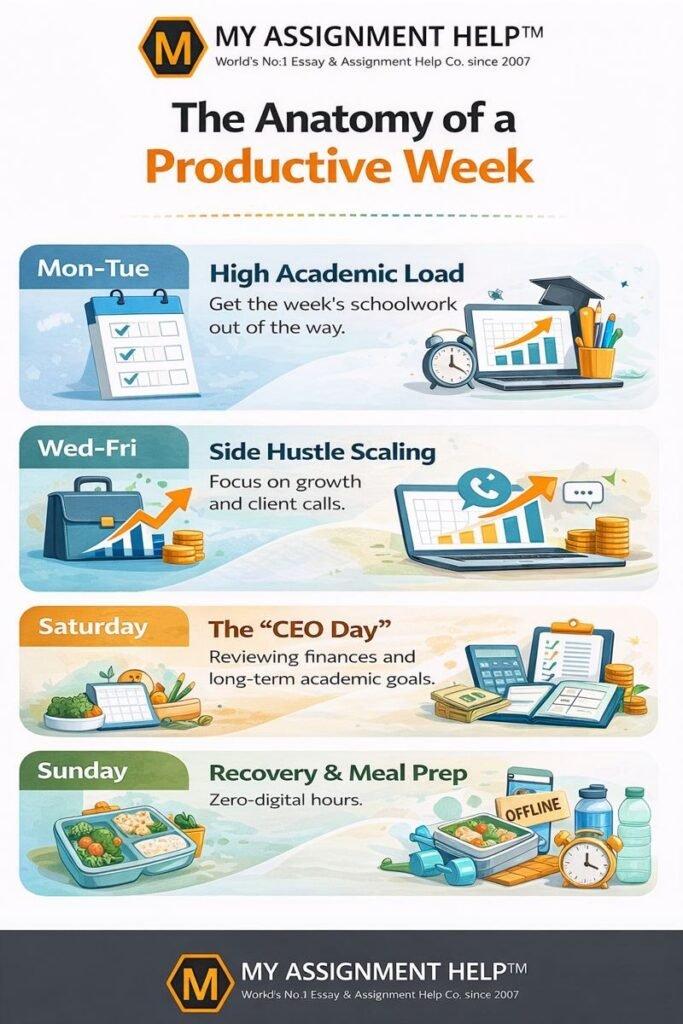
The Anatomy of a Productive Week
Frequently Asked Questions (FAQs)
Q: Is it legal to pay for academic assistance in the US?
Yes, using model writing services is legal and falls under “educational assistance.” It is a tutoring tool designed to provide a blueprint for your own original work.
Q: How do I manage taxes for my side hustle while being a student?
If you earn over $400, the IRS requires you to file. Many students use software like QuickBooks Solopreneur to automate this so it doesn’t eat into study time.
Q: What if my professor finds out I have a business?
Most US universities (like Stanford, MIT, and ASU) actually encourage this. Check if your school has a “Student Startup” clause that might grant you library perks or mentorship.
References & External Authorities
- U.S. Bureau of Labor Statistics (2025): The Rise of the Gig Economy in Gen Z Demographics. [Link to BLS.gov]
- National Center for Education Statistics (NCES): Student Workload and Graduation Success Rates. [Link to NCES.ed.gov]
- The Princeton Review (2026): Time Management Strategies for the Modern Campus.
- Journal of Business Venturing: The Impact of Academic Stress on Student Entrepreneurial Intent.
Author Bio
Morgan Hayes is a Lead Educational Strategist at MyAssignmentHelp and a former adjunct professor at a Top-20 US University. With a focus on neuro-productivity, Morgan has helped over 50,000 students navigate the intersection of career ambition and academic excellence. Morgan is a frequent contributor to Forbes Education and Wired.